

If you or your organization has anyone touching ChatGPT, Copilot, or a similar tool in connection with anything that could become a dispute, a contract negotiation, an HR matter, a safety incident, whatever, those conversations may already be evidence you’re obligated to preserve. Right now, you won’t know what a court will require until you’re standing in front of one.A federal court has already ruled that an expert’s prompts are fair discovery, no differently from their dataset or their model. If you’re general counsel, this ruling changes what a litigation hold may need to cover. If your experts, or your own staff, are prompting casually, without anyone thinking about retention, you may already have a preservation gap you don’t know about.
You might be tempted to treat this as a legal problem that only needs attention if it comes up. It isn’t. The cost of waiting is concrete, not theoretical.
Let’s say you delete or lose the wrong material, and the court sanctions you for spoliation. Or the court finds you mishandled the materials, and the protection you were counting on disappears. Work product protection only shields material you handled carefully. A scattered, incomplete record doesn’t just weaken your case. It can waive the protection entirely, handing the other side exactly what you were trying to keep private.
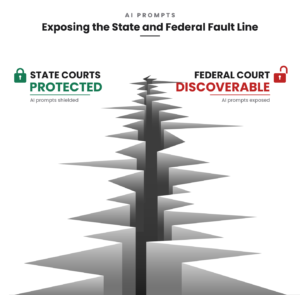
Exposing the State and Federal Fault Line
Within the same month, courts started pulling in opposite directions. One federal judge decided an expert’s AI prompts belong in the same category as their data and their models, fair game for discovery. Days later, two state courts reached the opposite conclusion, protecting AI conversations the way they’d protect a private conversation with counsel. Here’s exactly where federal and state courts have split, and why it matters for anyone using AI in connection with a dispute.
On May 18, a federal magistrate judge in Connecticut did something no federal court had done before. In Conservation Law Foundation v. Shell Oil, the judge ordered a climate scientist, Dr. Naomi Oreskes, to hand over the AI prompts she used while preparing her expert report. The theory was straightforward once you hear it: an expert’s methodology has always been fair game in discovery, whether that means the dataset they chose, the statistical model they ran, or now, the prompts they used to filter a mountain of documents. The court treated the prompt the same way it would treat a lab notebook.
That order is stayed right now, pending the plaintiff’s objection filed June 2. But stayed is not overturned. A federal court looked at how people are actually using AI in professional work and concluded the old discovery rules already cover it. Nobody wrote a new rule for this. The court applied Rule 26, the federal rule governing what must be handed over in a lawsuit, to a tool that didn’t exist when Rule 26 was written. That is another example of governance lag, caught in the act.
Nineteen days after the Shell Oil order, two state courts went the other direction, within a day of each other.
- On June 3, a Texas business court in Tate Group Automotive v. Legacy Automotive Capital extended work product protection to a party’s own ChatGPT chats, not just material an attorney prepared.
- On June 4, a New York court in Assini v. Hayward shielded a defendant’s ChatGPT conversations from subpoena entirely, comparing them to notes on a legal pad. Both courts went out of their way to distinguish an earlier federal ruling, United States v. Heppner, saying it simply didn’t apply under their standards.
So now we have a real fault line. Federal courts are leaning toward disclosure. Two state courts in two different states recognized protection within the same week. If you’re deciding how to treat AI use in anything that might end up in litigation, you cannot plan around which way a single court will lean. You have to assume you might land in front of either kind.

Your Obligation to Preserve
Here’s the part that should change how you think about all of this. The courts have made it clear that your AI use isn’t exempt from the rules that already govern how you handle evidence. Courts aren’t treating AI use as some strange new technology problem that needs its own special rules. They’re folding it into the same preservation and discovery rules that have governed business records for decades.
The courts are telling us this isn’t theoretical. Florida has already amended its procedural rules to hold attorneys more accountable for AI assisted filings, meaning lawyers now have a defined duty to check what the AI actually produced before it goes in front of a judge. The Ninth Circuit, one of the most influential federal appeals courts in the country, is actively working out how far that duty extends, specifically around catching AI hallucinations before they end up in a legal brief. Two different courts, two different angles, same direction of travel. The organizations writing their own rules for this now are the ones who won’t be found writing them for the first time in a deposition.
Here’s where the real exposure lives. The AI tools people use every day default to deleting logs in 90 days or less. Nobody is thinking about a legal hold when they’re troubleshooting a contract dispute with ChatGPT on a quiet afternoon. By the time counsel gets looped in, the evidence may already be gone, which creates an entirely separate problem: you can be penalized for losing evidence you had a duty to keep, even if the loss was routine and automatic rather than deliberate.
Here is your call to action. The organizations that come out ahead won’t be the ones hoping for a favorable judge. They’ll be the ones who did four things before anyone imagined their name in a case caption:
- They updated their litigation hold language to name prompts, outputs, logs, and metadata as their own category, not lumped in with generic documents.
- They mapped every AI platform actually in use across the company, sanctioned and unsanctioned, because you can’t preserve what you don’t know exists.
- They built a process to export and archive logs from public AI tools before the default deletion window closes, instead of finding out after the fact that the record is gone.
- They treated all of this as an operational control, the same as a records retention schedule, owned before litigation starts, not assembled in a panic once it does.
None of that is a legal department problem to solve later. It’s an operating decision to make now. Courts have already told us where this is headed. The only open question is whether your organization is one of the ones that listened.