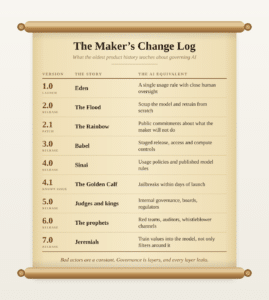
I want you to think about the chapters of the Old Testament like a product manager reviewing a changelog. From this perspective, I think you will find these accounts look less like a series of divine mood swings and more like a series of software releases. Each chapter responds to a failure in the narrative shared before.
Here are the release notes and change log, with a translation for anyone running AI today. Each one adds a control. And none of them ends the problem.
Makers who keep casting themselves as the Creator may be surprised and captivated, like Narcissus, by what they see in the pool. David Bentley Hart, in his essay on Narcissus and AI, warns, “Do not mistake the reflection for someone else.”
Whatever flaws appear in the reflection are the makers to own.
Release 2.0, the Flood: resets do not fix the environment
The Flood is the ultimate reset: wipe the whole system and start over from a copy that worked. It failed because the people who walked off the ark were the same people who walked on. The bugs came through the flood in every passenger. A few chapters later, Noah is passed out drunk in a vineyard, and his family is in crisis. A full reset is dramatic and costly. It treats the problem as a flaw in the product, when the real problem is the choices, people make with the freedom they were given.
Patch 2.1, the Rainbow: the most underrated patch
After the Flood, the maker does something unusual. It promises something about its own behavior. Never again will the reset button be used this way. Notice the direction of the control. It does not restrain the creation. It restrains the creator.
This is the part of AI governance that gets the least attention and builds the most trust. Published commitments, stated limits, and a willingness to be bound by your own rules are what make everyone else willing to rely on you. A maker who will not constrain itself has no standing to ask anyone else to.
Release 3.0, Babel: slow the spread
At Babel, everyone speaks the same language and shares one plan. They start building a tower to the sky. With the tower, nothing is beyond their reach. The maker’s answer is to mix up their languages so they can no longer work together, and the builders scatter. Nobody is punished for the tower. The maker breaks up the group before the project gets out of hand. The builders did not lack skill. They lacked restraint.
AI companies do something similar. They release a new model to a small group first, then widen access a little at a time. They limit who can use it and how much computing power it gets. The idea is simple. A tool is easier to fix when a few people use it than when millions do. And it works whether the people using it mean well or not.
Release 4.0, Sinai: write the rule down
At Sinai, expectations become text. The rules are written on tablets, public and specific, so anyone can point to them and say whether they were kept. A rule that lives in people’s heads is a game of telephone. By the third retelling, it is a different rule, and nobody can be held to it.
In AI, this is the usage policy: the published rules for what a model will and will not do. It gives users and regulators something to measure against, and it gives the maker something to be held to. Writing the rules down is the starting point. As the next release shows, it is not the finish line.
Known issue 4.1, the golden calf: rules broken before the ink dries
The timeline of the golden calf is the best joke in the book, and it is also a warning. While the rules are still being “carved in stone” for Moses to deliver from the mountain, the people below are melting jewelry and casting an idol. The tablets were still too hot to carry, and the party had started.
Anyone who has watched a new AI model launch knows this feeling. The usage policy is published on Monday. A jailbreak is circulating by Thursday. If your plan assumes that written rules will hold, you have planned for a world that has never existed. Rules are necessary. They are never sufficient, and the real measure is how quickly you notice a break and respond.
Release 5.0, judges and kings: delegate authority, but keep someone accountable
After the golden calf, the story moves authority from the maker to people. First come judges, then kings, because the people want a leader they can see. Governing is delegated to institutions. That scales, because the maker cannot supervise every decision directly. It also brings the usual problem: the institutions are run by the same flawed people they are meant to govern, and the kings are too often the first to bend the rules.
AI governance faces the same tradeoffs. Internal committees, risk boards, and outside regulators are how oversight scales past what any one builder can watch. They only work if someone is accountable for them. A board nobody answers to is a king nobody can check, which is why the prophets come next.
Release 6.0, the prophets: the best layer and the most ignored
The prophets are my favorite part of the stack. They are people outside the normal chain of command who say the uncomfortable thing out loud, and in the biblical story they are unpopular, dismissed, and sometimes thrown in a pit for their trouble. They are an independent early-warning system, and leaders who ignore them end up in exile.
My colleague David Childers founded EthicsPoint (now NavexGlobal), which built reporting channels so that organizations could hear from the people closest to the problem. He has a lasting soft spot for the whistleblower layer and has seen firsthand what happens when it is switched off. In AI, the modern prophets are red teams, outside auditors, incident reporting systems, and employees willing to file the report. If you only fund one layer beyond the basics, fund this one.
Release 7.0, Jeremiah: character and controls are partners
The later prophets describe a shift from rules carved in stone to values carried inside: integrity, transparency, accountability, and restraint. The first place to carry them is in the people and companies building AI. The same shift is happening in the models, which are now trained to behave honestly and avoid harm instead of only filtering their output. It is a real improvement. But even people of excellent character still have their work checked, and no serious organization drops its controls just because it hired someone good. Values on the inside and controls on the outside are two layers of one stack.
What the changelog really says
No single release solved the problem. Each one leaked, and each leak produced the next release. The system that emerges is not a perfect lock. It is defense in depth: reset capability, self-imposed limits, written rules, institutions, independent watchers, and internalized values, all running together because any one of them alone eventually fails.
That is the takeaway for anyone building or buying AI. Stop shopping for the unicorn control and build the stack. Every layer is going to leak, so the answer is several overlapping layers.
I said that if you fund only one layer beyond the basics, fund the prophets. Here is the question I would like you to answer. Who is the prophet in your organization? Who can say the uncomfortable thing about your AI out loud and not end up in the pit? If the answer is nobody, I would like to hear how you plan to fix that.
Next up: the one variable that never changes across any version of this history.