

Thought Leadership | Digital Transformation
Is Your Business Actually Digital? A 10-Point Check
Every organization I’ve worked with struggles with untrustworthy data not due to carelessness or bad systems, but because leadership never prioritized it, leaving it to IT. Invisible for months or years, the consequences hit at the worst moment: duplicate patient records, failed audit trails, lost nonprofit funding. The problem is organizational, not technical, and leaders must act to build organizations that actually work.
This is not criticism. Building a genuine digital business is hard, ongoing work not a project with a completion date.
The organizations that are furthest ahead are not the ones that made a single transformational investment. They are the ones who continuously examine their capabilities with honesty and close the gaps they find.
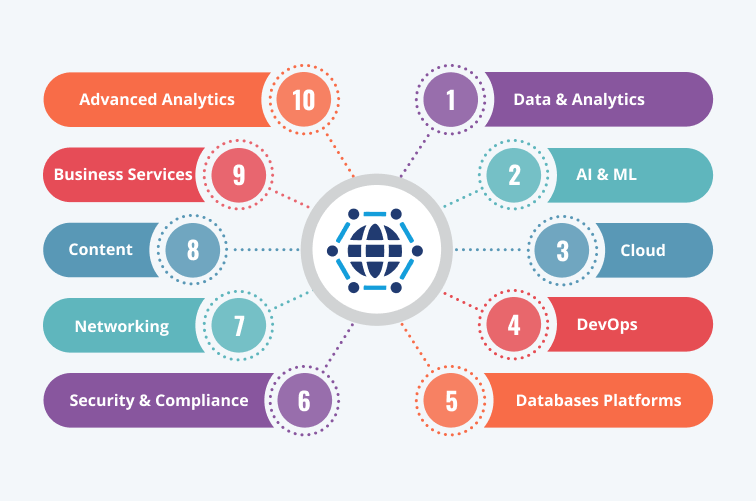
These ten areas represent the core pillars of a modern digital operation. For each one, I have included a brief description of what it means and a few questions worth sitting with honestly. Not every organization needs to be at the leading edge of all ten. But every leader should know where they stand.
The organizations furthest ahead are not the ones who made one big investment. They are the ones who examine their capabilities honestly and close the gaps they find.
1. Data & Analytics
Data and analytics are the nervous system of a digital organization. It is not just about having dashboards it is about whether your organization can collect, structure, and act on information in real time. The quality of your data determines the quality of every downstream decision, including those made by any AI or automation you introduce.
ASK YOURSELF:
- Can your leadership team access a single, trusted source of truth for operational data or do different departments work from different numbers?
- When you need to answer a new business question, how long does it take to get a reliable answer from your data?
- Do you have a documented data governance policy, and does someone own it with clear accountability?
2. Artificial Intelligence & Machine Learning
AI and ML are no longer emerging technologies they are operational realities for competitive organizations. But most businesses are either not using them at all or using surface-level tools without the foundational infrastructure to make them reliable. Real AI capability means having the data quality, the processing environment, and the organizational readiness to deploy models that actually improve outcomes.
ASK YOURSELF:
- Are you using AI in any operational workflows today, and if so, do you have a way to measure whether it is performing as intended?
- Is your underlying data clean and structured enough to train or fine-tune models or would an AI system amplify the inconsistencies already in your records?
- Does your leadership team have a point of view on where AI creates genuine value in your organization, or is adoption being driven by vendor pressure?
3. Cloud Services & Migration
Cloud is not a destination it is an ongoing architectural discipline. The question is no longer whether to use cloud, but whether your cloud strategy is intentional, cost-efficient, and actually enabling the agility it promised. Many organizations have moved workloads to the cloud without fundamentally changing how they operate, which means they are paying cloud prices for on-premise thinking.
ASK YOURSELF:
- Do you have a clear picture of what is in the cloud, what is on-premise, and why each is where it is or has your environment grown organically without a guiding architecture?
- Are your cloud costs predictable and governed, or do you experience regular surprises in your monthly bills?
- Have your teams actually changed how they develop and deploy applications to take advantage of cloud-native capabilities, or are they running legacy processes in a new environment?
4. Development & Operations (DevOps)
DevOps is the organizational and technical practice of delivering software reliably and continuously. Organizations that have not embraced it spend enormous energy on manual deployments, lengthy release cycles, and the coordination overhead of siloed development and operations teams. The result is slower innovation, more incidents, and higher cost all of which are competitive disadvantages that compound over time.
ASK YOURSELF:
- How long does it take your organization to move a change from development to production and how much of that time is waiting, not working?
- When something breaks in production, do you have automated monitoring and alerting in place, or do you find out from users?
- Are your development and operations teams genuinely collaborative, or do they operate in separate lanes with handoffs between them?
5. Databases & Platforms
The platforms and databases at the core of your operation are either enabling growth or constraining it. Legacy systems that cannot be easily queried, integrated, or extended create friction for every initiative that depends on them. Platform decisions made years ago for yesterday’s workloads may be silently limiting what is possible today.
ASK YOURSELF:
- Do your core systems integrate cleanly, or does your team spend significant time moving data between systems manually or through fragile custom integrations?
- Can your current database infrastructure handle the query volumes, data types, and processing speeds your next two years of growth will require?
- Do you have a documented platform roadmap, or are you making infrastructure decisions reactively as needs arise?
6. Security & Compliance
Security and compliance are not the same thing, and confusing them is expensive. Compliance is about meeting a defined standard. Security is about actually protecting your organization, your clients, and your data. In an environment where breaches are common and regulatory requirements are expanding, treating security as a checkbox exercise rather than a continuous discipline is a risk most organizations cannot afford.
ASK YOURSELF:
- Is your security posture proactive with regular assessments, penetration testing, and threat monitoring or reactive, addressed primarily after incidents?
- Do you have a clear, tested incident response plan, and does your leadership team know their roles in it?
- As your technology environment has grown and changed, has your security model kept pace or are there legacy gaps that have never been formally addressed?
7. Networking & Infrastructure
Infrastructure is the foundation on which everything else runs and, like most foundations, it is invisible until it fails. Organizations that have deferred infrastructure investment often discover the cost of that decision at the worst possible moment: during a growth initiative, a system migration, or a security incident. The question is not whether your infrastructure works today, but whether it can support what you are building toward.
ASK YOURSELF:
- Do you have documented infrastructure architecture, or has your environment grown organically in ways that only a few individuals fully understand?
- What is your current plan for infrastructure that is approaching the end of life and is that plan funded and scheduled?
- Does your infrastructure give you the visibility and control you need to respond quickly when something goes wrong?
8. Content & Media Management
For organizations that produce, manage, or distribute content at scale whether that is client documents, legal records, training materials, or media the ability to organize, retrieve, and govern that content is a direct operational capability. Poor content management creates compliance risk, reduces staff productivity, and makes institutional knowledge effectively inaccessible.
ASK YOURSELF:
- Can your organization reliably find the right version of a document when it is needed or do staff spend meaningful time searching, reconciling, or recreating content?
- Do you have clear policies for how content is classified, retained, and disposed of and do your systems actually enforce those policies?
- Is your content accessible to the people who need it, from the locations and devices they work from, without creating a security risk?
9. Business Optimization Services
Business optimization is about systematically removing friction from the processes that drive your organization. It requires the willingness to examine how work actually gets done not how it is supposed to get done and the discipline to redesign, automate, and measure the result. Organizations that invest in this consistently outperform those that add technology to broken processes.
ASK YOURSELF:
- Do you have a clear picture of your highest-cost, highest-volume operational processes and do you know where the inefficiencies in each of them live?
- When you introduce new technology, do you redesign the underlying process first, or do you automate the process as it currently exists?
- How do you measure operational efficiency today, and do those metrics actually change how decisions are made?
10. Advanced Analytics
Advanced analytics goes beyond reporting what happened to understanding why it happened, predicting what is likely to happen next, and prescribing what to do about it. It requires mature data infrastructure, analytical talent, and critically a leadership culture that is willing to make decisions based on evidence rather than intuition. Organizations that reach this level not only understand their business better; they also respond to it faster.
ASK YOURSELF:
- Are your analytics capabilities descriptive only telling you what happened or do you have predictive and prescriptive capability that informs decisions before outcomes are determined?
- Does your organization have the analytical talent to interpret and act on complex data, or is insight being left on the table because no one has the time or skill to extract it?
- Is data-driven decision-making genuinely embedded in your leadership culture, or is it reserved for certain functions while others still operate primarily on experience and instinct?
Where Do You Go From Here?
If you answered these questions honestly, you likely identified two or three areas where the gap between where you are and where you need to be is larger than you thought. That is not a failure it is information. The organizations that pull ahead are the ones that treat that information as a starting point rather than a verdict.
At iBridge, we work with organizations across all ten dimensions not to sell a standard engagement, but to understand where the real leverage lies and help close the right gaps in the right order. If any of these questions surfaced something worth a conversation, we would welcome it.